Great office design is about combining polished and professional spaces with amenities that allow employees to feel supported to do their best work. Yet in many workplaces, solid walls trap daylight at the building perimeter, leaving private offices, meeting rooms, and interior work areas dependent on artificial lighting.
Interior office windows offer a smart solution: they distribute daylight throughout the space while maintaining the separation teams need to focus, meet, and collaborate. They borrow light from other spaces, provide visibility, and support effective space planning without sacrificing needed boundaries.
For a design-build firm like Key Interiors, interior glazing is intentional. It is a coordinated architectural strategy that balances light, privacy, acoustics, code requirements, and budget from the earliest planning stages.
Why Workplace Natural Light Matters
Access to daylight can support visual comfort, alertness, and satisfaction with the work environment. Research comparing windowed and windowless offices has also associated greater daylight exposure with better sleep outcomes and measures of well-being. Put simply, workplace natural light is part of a people-centered workplace strategy, not just an aesthetic upgrade.
Exterior windows deliver the daylight, but the interior layout determines who gets to benefit from it. When enclosed rooms line the perimeter, they can block light from reaching shared spaces and central workstations. Glass office walls turn daylight into a resource that can be shared across the entire floor, allowing natural light to travel well past the corner offices.
How Interior Office Windows Support Productivity
1. They carry daylight deeper into the office
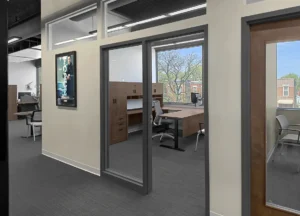
Glass sidelights, clerestory windows, and full-height glazed partitions allow light to move beyond exterior-facing rooms. This can brighten circulation paths, collaboration zones, and workstations that would otherwise feel disconnected from the outdoors.
2. They improve visibility and connection
Interior office windows create visual connections between teams without removing every boundary. Employees can see whether a room is occupied, locate colleagues, and stay connected to activity around them. The result is a workplace that feels more open and navigable while still supporting defined zones, especially when glass office walls are coordinated with careful furniture planning.
3. They balance focus with collaboration
An open plan is not the only way to encourage teamwork. Glazed rooms can provide acoustic separation for calls, meetings, and focused tasks while preserving daylight and visual openness. With the right glass type and wall assembly, you can create spaces that feel connected without sacrificing function.
Although not all interior office windows are fully soundproof, many systems offer elevated acoustic performance using laminated glass, sealed frames, and acoustic doors to meet typical office privacy needs.
Interior Office Window Options to Consider
Depending on your office layout and the functions of each space, some options may fit better than others.
- Full-height glass partitions: Maximize daylight transfer and create a clean, contemporary look.
- Clerestory windows: Bring light over solid walls while preserving privacy at eye level.
- Door sidelights: Add visibility and borrowed light with a relatively small footprint.
- Framed glass walls: Introduce architectural rhythm and complement industrial or traditional interiors.
- Frosted or patterned glazing: Filter views in sensitive spaces while still allowing light to pass.
- Switchable privacy glass: Provide flexible transparency for conference rooms or executive offices when the budget and use case support it.
Design Details That Make Interior Glazing Work
A design-build team should evaluate the complete workplace system, including solar orientation, glare control, privacy needs, acoustics, safety and code compliance, mechanical coordination, and maintenance. These factors determine how interior office windows affect natural light distribution, minimize glare, and achieve the right balance of transparency and privacy.
For acoustics specifically, selecting laminated glass, upgrading seals, and coordinating adjacent wall assemblies can make glass office walls perform well for speech privacy, even if they are not entirely soundproof.
A Design-Build Approach Reduces Risk
Because interior glazing touches architecture, engineering, procurement, and construction, early coordination matters. Under a design-build model, designers, estimators, trade partners, and builders can evaluate options together. That collaboration helps align the desired look with acoustic performance, lead times, installation requirements, and total project cost before decisions become expensive to change.
The team can also study how interior office windows interact with furniture and circulation, ensuring transparency improves the employee experience rather than creating distractions.
Where Interior Office Windows Deliver the Most Value
Interior glazing can be especially effective along perimeter offices, conference rooms, huddle rooms, training spaces, reception areas, shared corridors, and enclosed collaboration zones. The best opportunities often appear where a solid wall currently separates an exterior window from the center of the floor plate.
During an office renovation, start by mapping daylight paths and ranking spaces by privacy and acoustic needs to determine where clear glass, translucent glass, a clerestory, or a traditional solid wall will perform best.
Build a Brighter, More Productive Workplace
Thoughtfully planned interior office windows can help organizations share daylight, improve visual connection, and create more inviting work settings. When glazing is integrated with acoustics, privacy, glare control, and building systems, it becomes a practical tool for strengthening workplace natural light and supporting productivity.
If you’re ready to rethink your office and add some light to the space, contact us today. The Key Interiors design-build team can assess your space for daylight opportunities, compare glass office walls and window options, and create a workplace that is as beautiful as it is functional.