Peak season puts every part of a fulfillment operation under pressure. Orders rise, receiving accelerates, pick paths become crowded, and packing stations back up faster than expected. If your warehousing was designed around average volume, those stresses can quickly lead to late shipments, picking errors, safety concerns, and frustrated customers when holiday orders surge and e-commerce demand spikes.
Peak-season readiness may seem like an easy fix with staffing or software changes, but the root of the problem is typically poor facility design. A well-planned distribution center layout creates a clear, efficient path from receiving through storage, picking, packing, staging, and shipping. The best time to assess that path is before demand peaks and when your team can still correct bottlenecks without disrupting your busiest weeks of holiday order fulfillment.
Why Distribution Center Layout Matters During Peak Season
Every unnecessary turn, long walk, crossing traffic pattern, or undersized staging area becomes more costly as volume increases. Effective distribution center layout planning starts by mapping the full movement of products, people, equipment, and information. Receiving, putaway, replenishment, picking, packing, returns, and outbound shipping should work as a connected system rather than a collection of isolated zones.
A peak-ready layout should help your operation:
- Shorten travel distances for high-velocity products
- Separate pedestrian, lift-truck, and automated equipment routes
- Prevent inbound and outbound traffic from competing for the same space
- Provide adequate room for packing, sortation, and carrier staging
- Make workflows intuitive for seasonal employees
- Support temporary surges without blocking aisles, exits, or fire protection
Seven Signs Your Warehouse May Not Be Peak-Ready
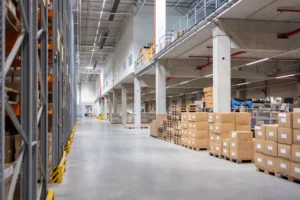
If any of these situations apply to your facility during high-demand periods, your facility may not be prepared to take on this next round of holiday orders.
- Fast-moving SKUs are stored too far from packing. Long pick routes multiply during high-volume periods and consume labor that could be spent completing order fulfillment tasks.
- Receiving and shipping traffic overlap. Cross-traffic creates congestion, increases handling, and raises the risk of delays or incidents.
- Packing stations cannot absorb order spikes. Insufficient work surfaces, power, lighting, storage, or conveyor access can turn packing into the facility’s primary bottleneck during e-commerce peaks.
- Outbound staging regularly spills into aisles. If completed orders have no organized place to wait for carrier pickup, docks and travel lanes can become blocked.
- Returns have no dedicated process area. Peak sales are often followed by peak returns. Without a defined inspection, restocking, and disposition zone, returned goods can interfere with outbound fulfillment.
- Seasonal staff struggle to navigate the building. Confusing zoning, inconsistent signage, and poorly marked routes slow training and increase errors when warehousing teams scale up for holiday orders.
- Utilities and building systems are at capacity. Added equipment, temporary stations, charging needs, lighting, ventilation, data, or climate control may exceed what an older facility can reliably support.
Retrofit Your Existing Warehouse for Faster Fulfillment
A new building is not always the right answer. Many existing warehouses can be reconfigured to support e-commerce and high-volume fulfillment through targeted improvements.
Key Interiors can evaluate how your current shell, systems, and workflow align with operational goals, then develop a phased retrofit strategy that prioritizes the changes with the greatest impact.
Depending on the facility, a retrofit may include:
- Reconfiguring receiving, storage, pick, pack, and ship zones
- Relocating or adding packing and value-added service stations
- Improving dock and outbound staging capacity
- Upgrading lighting, power, data, HVAC, and charging infrastructure
- Installing durable finishes and floor systems suited to traffic and cleaning demands
- Creating safer circulation, wayfinding, and employee support areas
- Phasing construction to limit disruption to active operations
Because Key Interiors brings design, preconstruction, engineering coordination, and construction together, layout decisions can be evaluated alongside budget, schedule, constructability, and operational continuity. That integrated approach helps reduce handoff gaps and keeps a warehouse retrofit focused on measurable facility performance for e-commerce growth.
Prepare Your Warehouse Before the Rush
Peak season exposes weaknesses that remain hidden during normal volume. Addressing distribution center layout, warehouse facility design, packaging flow, and building infrastructure before demand surges can improve throughput, support safer work, and protect the customer experience. Proactive warehousing improvements support order fulfillment resilience when e-commerce volume spikes and holiday orders arrive in waves.
Is your facility ready? Contact us today to evaluate your existing warehouse, identify high-impact retrofit opportunities, and create an integrated design-build plan for peak-season performance and long-term growth.