In medical device manufacturing, consistency and quality are heavily influenced by the environment in which products are made. The design and build of a facility play a direct role in how well a company can meet ISO standards, particularly those tied to quality management and cleanroom performance.
Strategic commercial construction ensures that these standards are not an afterthought. Key Interiors takes this approach from the start, building ISO considerations directly into the foundation of the space to support reliable operations and smoother certification processes.
Why ISO Standards Matter in Facility Design
ISO standards provide a framework for maintaining quality, consistency, and safety across medical device manufacturing. Among the most relevant are ISO 13485, which focuses on quality management systems, and ISO 14644, which governs cleanroom environments.
While these standards are often discussed in terms of documentation and processes, the physical space plays a major role in supporting them. Commercial construction decisions such as layout, materials, and infrastructure directly impact how easily teams can meet and maintain ISO requirements.
Building Cleanrooms to Meet ISO 14644 Standards
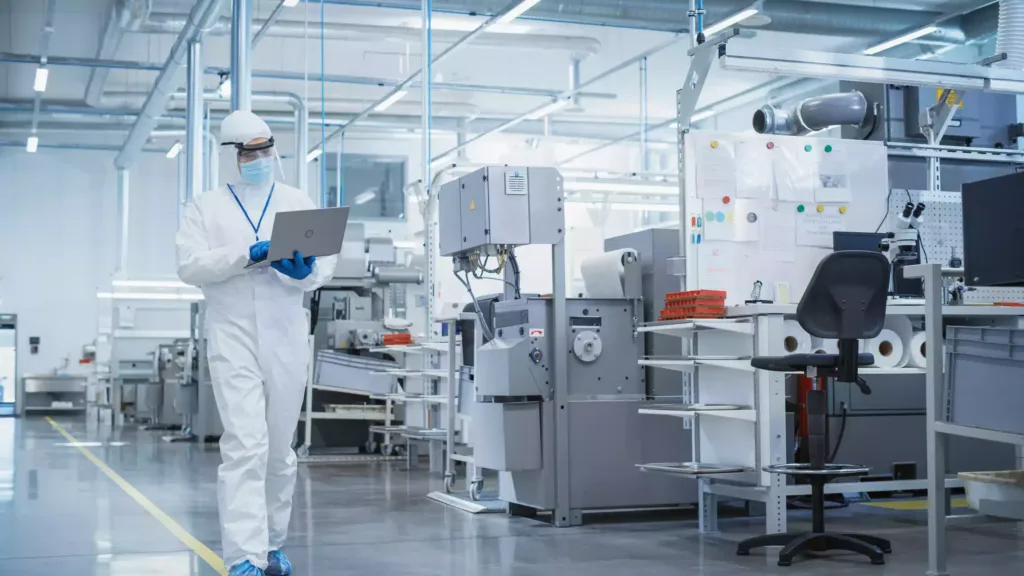
For many medical device manufacturers, cleanrooms are a critical part of the operation. ISO 14644 outlines how clean these environments must be, based on the level of airborne particles allowed. ISO 14644-2 focuses on maintaining cleanroom performance over time by establishing requirements for ongoing monitoring. It outlines how to regularly test and verify that air cleanliness levels continue to meet the specified ISO classification during normal operations.
Commercial construction plays a key role in achieving and maintaining these standards. This includes:
- Designing proper airflow systems to control airborne particles
- Building airtight spaces to maintain consistent conditions
- Using smooth, easy-to-clean materials that limit particle buildup
Even small construction details can affect cleanroom performance, making it essential to get the design right from the start.
Understanding Airborne Particle Filtration
Airborne particles are microscopic solids or liquid droplets such as dust, skin cells, fibers, or aerosols that can contaminate sensitive processes and products. In controlled environments like cleanrooms, these particles are managed because even small concentrations can impact quality, especially in industries like medical device or electronics manufacturing.
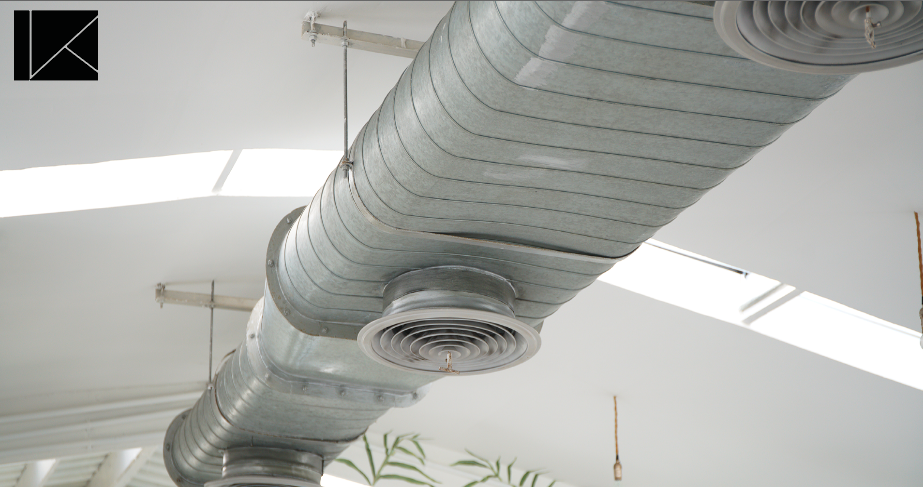
Filtration is the primary method for controlling airborne particles. Cleanrooms rely on high-efficiency filters such as HEPA (High-Efficiency Particulate Air) filters to capture particles as air circulates through the space. These systems continuously pull in air, remove contaminants, and recirculate clean air back into the room. Airflow design also matters; consistent, directional airflow helps prevent particle buildup and keeps contaminants moving toward return vents and filtration units.
ISO cleanroom classifications define how many particles are allowed per cubic meter of air at specific particle sizes. The higher the class number, the less stringent the cleanliness requirement:
- ISO Class 5 requires very low particle concentrations and is used in highly controlled environments such as sterile manufacturing and critical cleanroom operations, where even microscopic contamination can impact product integrity.
- ISO Class 7 allows a relatively low concentration of particles and is commonly used for more controlled manufacturing environments, including certain medical device processes.
- ISO Class 8 permits a higher particle count and is often used for less sensitive manufacturing settings or as a buffer zone leading into cleaner areas.
- ISO Class 9 is the least strict classification and is roughly equivalent to typical indoor air in a well-controlled commercial or industrial space.
Each class requires appropriate filtration, airflow, and monitoring strategies to maintain compliance, with tighter classes demanding more rigorous control systems and operational discipline.
Designing for Easier Audits and Ongoing Compliance
ISO certification involves regular audits, and the facility itself is always part of the evaluation. A well-constructed space makes these audits more straightforward.
Features that support audit readiness include:
- Clearly defined production and support areas
- Logical flow of people and materials
- Surfaces that are easy to clean and inspect
- Systems that support monitoring and documentation
The Value of the Right Commercial Construction Partner
 Designing a facility that supports ISO standards requires more than general construction knowledge. It takes an understanding of how space, workflow, and compliance intersect.
At Key Interiors, we work with medical device manufacturers to deliver commercial construction solutions that align with ISO requirements and real-world operations. Our focus is on creating environments that are practical, efficient, and built to support long-term success.
Build with ISO Standards in Mind
Meeting ISO standards starts with the right foundation. With thoughtful commercial construction, manufacturers can create facilities that support quality, streamline operations, and simplify the path to certification.
If you’re planning a new build or upgrading your current space, partner with a commercial construction team that understands how to turn ISO requirements into a functional, high-performing environment. Contact us today to discuss your project’s needs.