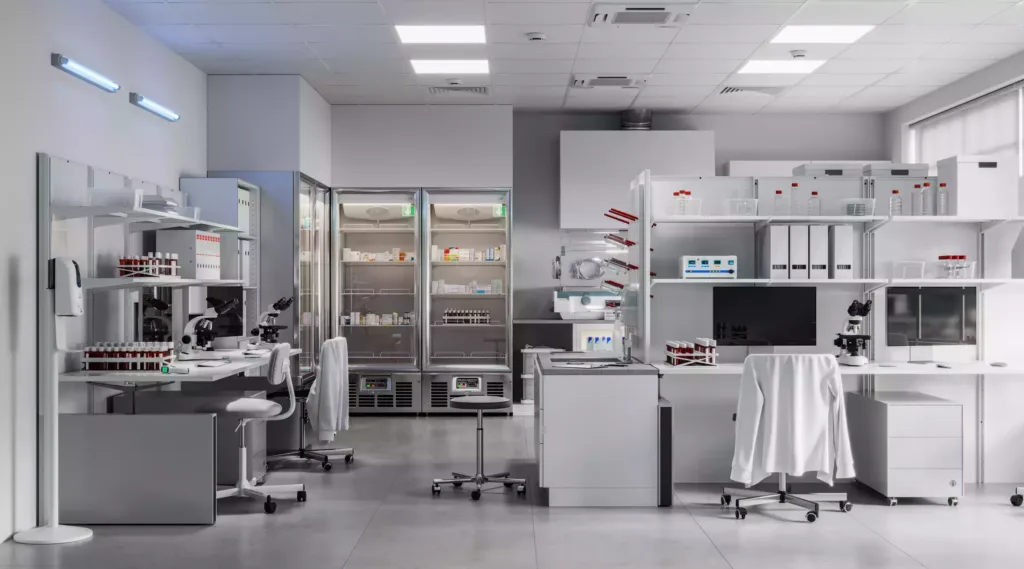
When it comes to renovating laboratories, cleanrooms, and other critical environments in food & beverage, pharmaceutical, medical device manufacturing, defense manufacturing, and life sciences facilities the planning and design must support complex workflows while meeting strict certification and compliance standards and security protocol. Renovating existing research and development facilities, or manufacturing facilities in which it’s critical to protect products from contamination, adds another layer of complexity, especially when operations must continue uninterrupted.
As a leading firm for performing designing and renovating these critical environments, Key Interiors knows that a successful renovation must balance flexibility and compliance with the need for growth. Here’s how thoughtful design and execution from our team can make your renovation a success.
Designing for Flexibility
Science and technology evolve quickly, and facilities must be able to keep pace. Rigid layouts can limit future capabilities and lead to costly rework.
Flexible design strategies include modular lab and cleanroom layouts, modular machine enclosures, movable casework, and adaptable benching systems that allow spaces to be reconfigured as research focus shifts. Utility distribution systems such as overhead service carriers or accessible interstitial spaces make it easier to modify power, data, gas, and plumbing without invasive construction.
By prioritizing flexibility during planning and design, facilities can extend the lifespan of their investment and respond more efficiently to changing demands.
Planning for Scalability and Long-Term Growth
Growth is a constant in these organizations, due to product innovation and testing, expanded research programs, increased staffing, or the installation of new equipment and production lines. Renovations should anticipate these changes rather than react to them.
A scalable design considers future headcount, equipment loads, and process expansion. This may involve upsizing mechanical, electrical, and plumbing (MEP) systems, designing structural capacity for heavier equipment, or creating shell space that can be built out later with minimal disruption.
Thoughtful scalability planning helps organizations avoid repeated renovations and ensures facilities can grow alongside scientific advancement.
Navigating Compliance, and Regulatory, and Certification Requirements
Compliance is non-negotiable in these environments. Renovations must align with a complex framework of regulations and standards, which may include FDA guidelines, GMP and GLP requirements, ISO classifications, and local building and safety codes.
Successful projects integrate compliance into the design process from the start. This includes proper material selection, cleanability considerations, controlled access, and documentation-ready systems. Validation planning, such as commissioning and qualification of systems, should also be incorporated early to prevent delays at project closeout.
Designing with compliance in mind reduces risk, supports audits, and protects the integrity of research and production activities.
Supporting Ongoing Operations During Renovation
Many renovations occur in occupied, fully functioning facilities. Phased construction, temporary containment, and precise coordination are essential to protect sensitive environments and maintain operational continuity.
Strategies may include isolating work zones, maintaining pressure differentials, controlling vibration and noise, and scheduling disruptive activities during off-hours. Clear communication with facility managers and scientific staff ensures expectations are aligned and risks are minimized.
Integrating Technology and Infrastructure Upgrades
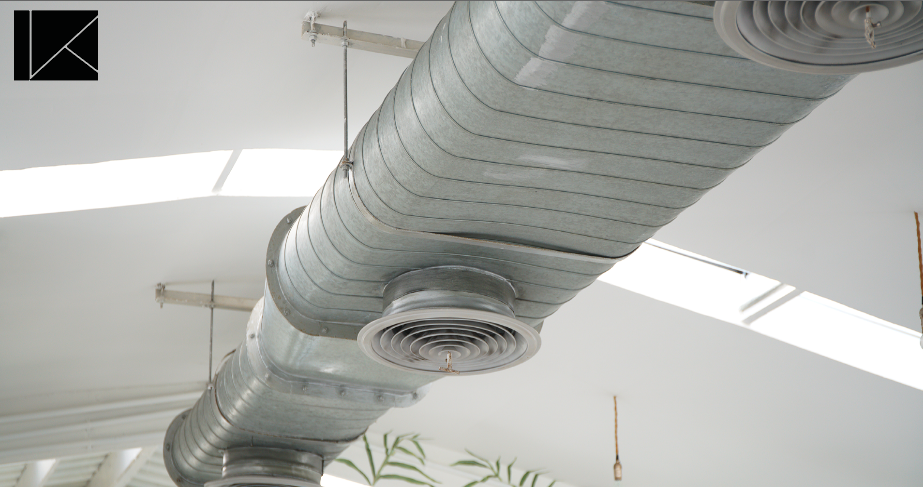
 Renovation provides an opportunity to modernize aging infrastructure. Upgraded HVAC systems, improved air change rates, enhanced filtration, and smarter building controls can significantly improve performance, efficiency, and compliance.
Technology integration such as building management systems, temperature and humidity controls, monitoring sensors, and access control also supports data integrity, environmental stability, and operational visibility across the facility.
Partnering With the Right Renovation Team
Renovating a research and development, food & beverage, pharmaceutical, biomedical and defense facility demands specialized expertise. The right partner understands not only construction and design, but also the operational, regulatory, and technical realities of these environments.
At Key Interiors, we bring a collaborative, detail-driven approach to these projects. Our team works closely with stakeholders to deliver flexible, scalable, and compliant spaces that support innovation without compromising daily operations.
Planning a renovation? Contact Key Interiors to learn how we can help future-proof your facility while meeting the highest standards of performance and compliance.